
How to prepare the Annual Financial Report: A step-by-step walkthrough for your PTA

| Time to Read |
|
| What You'll Learn |
|
| Next Steps |
|
Preparing your PTA's annual financial report can feel pretty intimidating, especially if you're a volunteer who's stepped into the treasurer role without a background in accounting.
So before you stress out, take a breath and remember, the goal of the report isn't to prove that you're a financial expert. It's to document what money came in, what went out, and where your PTA stands at the end of its fiscal or calendar year.
Below, we walk you through the process step by step, using plain language and practical checks. You can make the process even easier by using our accounting platform designed for PTAs and schools!
Step 1: Confirm your reporting period

Before you pull a single report, make sure you're working within the right time frame.
Most PTAs operate on a fiscal year (often July 1 to June 30), while many IRS forms use a calendar year (January 1 to December 31). Mixing these up is one of the most common sources of confusion later on.
What to do first
- Check your PTA bylaws to confirm your fiscal year.
- Lock in the exact start and end dates for your annual report.
- Keep calendar-year totals available separately in the event of IRS cross-checks.
The IRS allows tax-exempt organizations (which most PTAs are) to file on either a fiscal or calendar year basis, but consistency matters.
Step 2: Gather all income for the full year

Your first major task to prepare your PTA's annual financial report is to account for every single dollar the PTA received during the fiscal (and eventually calendar) year.
This includes money from online fundraising platforms like FutureFund, such as:
- Membership dues
- Event ticket sales
- Spirit wear or merchandise
- Cash and check deposits
- Sponsorships and donations
It's important that you focus on gross income, not just the amount in the bank afterwards. Also, keep in mind that chargebacks, processing fees, and refunds will need to be tracked separately, even though they still start as income.
Common things to watch for
- Cash collected at events that didn't make it into reports
- Refunds that reduce deposits but still count toward gross totals
- Late deposits that belong to that year, but are posted after the fiscal cutoff
While most income that PTAs receive throughout the year will be tax-exempt, there are a few sources of income that can potentially be subject to UBIT (Unrelated Business Income Tax), such as operating a student store open daily during lunch, selling spirit wear all year, or even the operation of a concession stand at every home game.
If your PTA has a gross UBIT of $1000 or more, you'll need to file a separate Form 990-T in addition to the regular Form 990 series that you'll already be filing.
The IRS has a broad definition of tax-exempt organizations, and your totals should reflect all funds raised, not just net deposits.
Step 3: Collect and categorize all expenses

You've listed out where the money came from, now it's time to document where it went.
Expenses for your PTA will typically fall into these categories (this is not an exhaustive list):
- Programs and events
- Fundraising costs
- Supplies
- Insurance
- Software and payment processing fees
- Professional services
Things to keep in mind
You should always use consistent categories from year to year. That way, your reports are easier to understand, and it reduces questions during audits or board reviews.
Keep receipts or documentation tied to each expense whenever possible. Clear expense records aren't just for your PTA's internal reports, they also support how expenses are reported on IRS forms.
Luckily, the IRS provides detailed instructions on expense reporting for tax-exempt organizations on its website.
Step 4: Reconcile every account to the final month
Reconciliation is where everything comes together, and where many issues get caught. But what, exactly, does it mean?
Reconciling accounts to the final month means making sure that your records match exactly what your bank and payment platforms show as of the last day of your reporting period.
To reconcile, you'll compare your records against:
- Bank statements
- Payment processor summaries
- Online fundraising platforms
A reconciled account means...
- Your ending bank balance matches your books
- Every deposit and withdrawal is accounted for
- Outstanding checks are listed and explained
- Timing differences are documented
Don't skip this step! Reconciliation is what ensures your totals match third-party records (like bank statements and Form 1099-Ks), and that there are no missing transactions or unexplained discrepancies.
Step 5: Build your three core financial statements

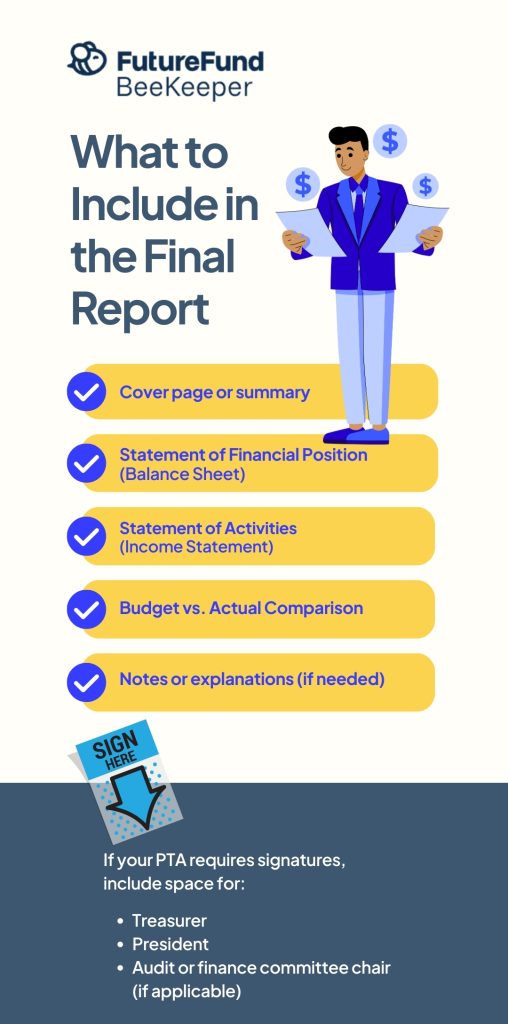
Once your numbers are complete and reconciled, you're ready to turn all that data into the actual annual financial report. Most PTA reports are built around three core statements, and together, they tell the full story of your PTA's finances: where you started, what happened during the year, and where you ended.
Statement of Financial Position (balance sheet)
The Statement of Financial Position shows your PTA's financial snapshot at the end of your fiscal year. It answers the questions, "What does our PTA have? And what does it owe, right now?"
This statement typically includes:
- Cash balances across all PTA bank accounts
- Outstanding liabilities, like unpaid bills or outstanding checks
- Net assets, which represent the funds your PTA has available (including any restricted funds set aside for specific purposes, like prom)
Boards often use this balance sheet to confirm that the PTA is financially stable and that funds are being held appropriately at year-end.
Statement of Activities (income statement)
The Statement of Activities summarizes everything that happened financially within the PTA during the year.
It shows:
- Total income, broken down by source (fundraising, donations, membership dues, etc.)
- Total expenses grouped by category
- The resulting surplus or deficit for the year
The Income Statement is especially important because it connects directly to your PTA's IRS filings. The totals here need to align with what you (or your tax preparer) later report on Form 990-N, 990-EZ, or 990. If the numbers don't make sense here, they won't make sense to the IRS either.
Budget vs. Actual Comparison
The Budget vs. Actual Comparison report compares what your PTA had originally planned to do throughout the fiscal year with what actually happened.
It should include:
- The original board-approved budget
- Actual income and expenses
- The difference (variance) between the two
Boards rely heavily on this report because it demonstrates financial stewardship. Significant differences aren't automatically a problem, but you'll still need to explain them. A short note like "Spring fundraiser exceeded expectations" or "Assembly costs increased due to vendor pricing" can prevent confusion and unnecessary concern.
Taken together, these three statements create a complete, transparent financial picture. They make it easier for your board to adopt the report, auditors to review it, and future treasurers to understand exactly where things stand.
Step 6: Cross-check core statements before board review
Before your annual financial report goes to the board, do a targeted review of the key totals and relationships between statements. This structured cross-check will confirm that your numbers tell a consistent story.
Walk through the report in this order:
Statement of Financial Position
- Ending cash balance: This should match your reconciled bank balance as of the final month.
- Outstanding liabilities: Any unpaid bills or outstanding checks should still appear here.
- Net assets: This figure should reflect prior-year net assets plus or minus the current year's surplus or deficit.
Statement of Activities
- Total income: Confirm that this matches the income totals you compiled in step two.
- Total expenses: Confirm this matches the expense totals you compiled in step three. Ensure major programs, fundraisers, and known costs appear once and in the right category.
- Surplus or deficit: This number explains the change in net assets from the previous year.
If income or expenses don't align with your source reports, correct them before sending them off to the board.
Budget vs. actual comparison
- Budgeted totals: These numbers should match the board-approved budget from the beginning of the year.
- Actual totals: This section should match the totals you compiled on your Statement of Activities.
- Large variances: Identify any material differences that may prompt questions from the board.
Finalize the report
Your report is now ready to be finalized and submitted to the board. At this point, all three core statements should reflect the same fiscal year, totals should be consistent across reports, and no draft or provisional numbers should remain.
When your annual financial report is presented to the board, they'll save it with your PTA's permanent record so that it can be easily referenced for audits and future IRS filings, like Form 990-N.
Know which IRS forms your PTA needs to file
Most PTAs are federally recognized as 501(c)(3) tax-exempt organizations, which means they must file an annual informational return with the IRS. The specific forms your PTA will be required to file will depend on how much money your PTA brought in and, in some cases, how it was earned.
This is where your annual financial report comes in. It provides the totals and documentation that will determine which forms apply and ensures they're completed accurately.
The Form 990 series (required every year)
Every PTA must file one form from the Form 990 series. Which one you file depends on your gross receipts (total income before expenses):
- Form 990-N for PTAs whose annual gross receipts total $50,000 or less
- Form 990-EZ for PTAs whose annual gross receipts total between $50,000 and $200,000, and with total assets less than $500,000
- Form 990 for PTAs with annual gross receipts of $200,000 or more, or total assets of $500,000 or more.
Additional federal forms some PTAs may need
Depending on your PTA's activity throughout the fiscal year, some additional forms may apply, including:
- Schedule A: All PTAs that are exempt under Section 501(c)(3) must attach Schedule A to Form 990 or 990-EZ. It confirms your tax-exempt status and public charity classification.
- Form 990-T for PTAs that earned $1,000 or more in gross income from unrelated business activities, like ongoing commercial sales not tied to your exempt purpose.
- Form 1099-NEC or 1099-MISC for PTAs that paid an independent contractor $600 or more during the fiscal year (i.e., for an assembly presenter, consultant, prom DJ, etc.).
- Form 8868 for PTAs who find themselves needing more time to file. This form provides them with an automatic six-month extension.
Final thoughts from our tax team
You don't need to be an expert accountant to prepare your PTA's annual financial report. You just need a straightforward process and complete records. When income and expenses are organized, accounts are reconciled, and reports are reviewed before finalizing, everything else just falls into place.
Try Beekeeper's accounting platform for schools to keep these steps simple and repeatable each year. From automatic bank imports to expense reimbursements, budgeting tools, and account reconciliation, you'll find everything you need to prepare annual reports that give your board confidence and support your IRS filings.
Cameron Martel is FutureFunds' chief marketing officer. He focuses on helping FutureFunders get more from their fundraising, helping their online stores reach more customers, and generally empowering the people that are building the next generation of students.